7 min read
EDC, EDT, EDP, and Extrait: Why Oil Percentage Doesn't Tell the Whole Longevity Story
Higher concentration means longer wear — right? Not always. Here is the physics of alcohol lift, oil weight, and why Extraits whisper closer.
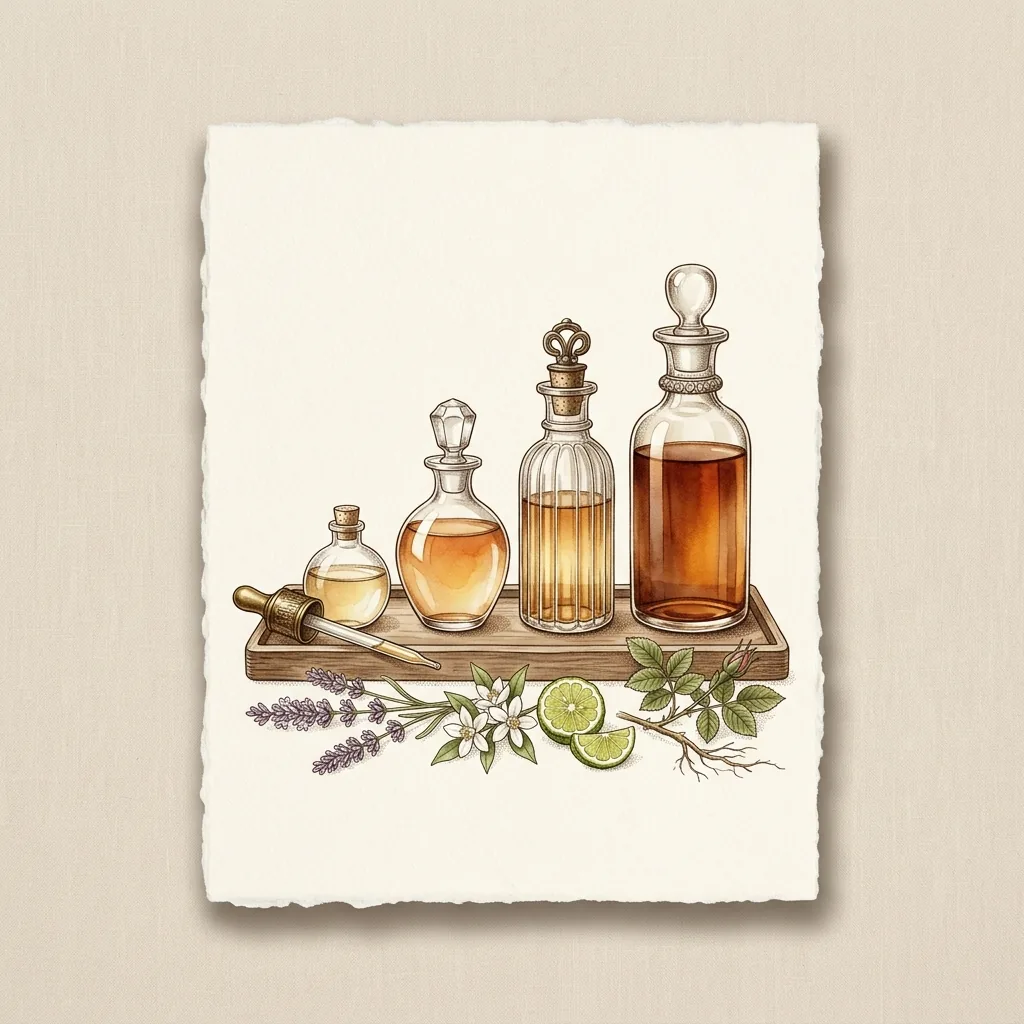
Stand at any fragrance counter long enough and you will hear the same confident rule repeated like scripture: the higher the oil concentration on the label, the stronger and longer-lasting the bottle. Collectors automatically pass over Eau de Toilette for Eau de Parfum, and treat Extrait de Parfum as guaranteed twelve-hour armor. Yet anyone who has worn a bracing citrus Extrait that faded before lunch — followed by a woody-amber EDT still humming on a shirt collar at midnight — already suspects that percentage alone tells only half the physical story.
The four classic concentration tiers decoded
Traditional French nomenclature sorts alcoholic fragrances by the ratio of aromatic compound (the pure perfume concentrate) to solvent, which consists of high-proof perfumer's ethanol and a trace of distilled water. Eau de Cologne (EDC) sits at the brisk entry point, typically between 2% and 5% oil, built for lavish splashes of lemon, neroli, and rosemary. Eau de Toilette (EDT) raises that load to roughly 8% to 15%, offering lively lift for daily wear. Eau de Parfum (EDP) occupies the sweet spot of 15% to 20%, balancing airiness with deeper heart and base density, while Extrait de Parfum — often simply labelled Parfum — concentrates aromatic oils between 20% and 40%. Crucially, these brackets are industry custom rather than strict international law: one atelier's dense 14% EDT can easily outweigh another brand's airy 18% EDP.
Alcohol lift: why lower concentrations often project louder
To understand projection, stop looking at the oil and watch the alcohol. Denatured ethanol is radically more volatile than fragrant resins or floral absolutes. The instant an EDT atomizes onto warm skin, its large proportion of alcohol flashes into vapor, creating a convective plume that carries volatile top notes outward into the room. That burst of evaporation is what turns heads two meters away during the first hour.
An Extrait behaves under very different fluid physics. Packed with 25% to 35% viscous oils and far less free ethanol, it dries down slowly into a sleek, concentrated film along the epidermis rather than exploding into the air. Instead of shouting across an elevator, a great Extrait radiates through body warmth in a dense, tactile halo within arm's reach — whispering closer to the skin while refusing to wash out.
Molecular weight beats raw oil percentage
Longevity depends above all on vapor pressure and molecular weight, not the integer printed on the box. Terpenes abundant in expressed bergamot, grapefruit, and bitter orange weigh very little and leap off skin inside sixty to ninety minutes — even if bottled at Extrait strength. Without heavier fixatives underneath, high percentage merely buys a thicker citrus splash.
By contrast, macrocyclic musks, labdanum resinoids, patchouli, sandalwood sesquiterpenes, cashmeran, and birch-tar leather accords possess massive, slow-moving structures that interlock with skin lipids and fabric weave. A well-built 12% woody-amber EDT easily outlives a 25% pure hesperidic Extrait by six hours or more. Moreover, perfumers do not simply pour extra water out when creating an Extrait flanker; they re-orchestrate the formula, dialing down sharp top volatility while amplifying creamy florals, spiced woods, and resinous depth.
Choosing the right concentration for heat and occasion
Smart collectors match format to temperature and space rather than chasing the thickest bottle blindly. Under blistering 42°C Gulf afternoon sun, heat accelerates evaporation across every tier, making brisk EDTs and luminous EDPs with crisp citrus-woody spines feel effortless rather than cloying. Save velvety Extraits for cool evening air, formal gatherings, and pulse points where cardamom spice, sun-drenched tuberose, leather, and cashmeran can unfold unhurriedly from dusk into the small hours.
Discover how rich concentration meets magnetic warmth with Fakhar Extrait by Lattafa — an opulent blend of cardamom, sparkling grapefruit, tuberose, solar notes, supple leather, and velvety cashmeran.