6 min read
Shade Under the Fig Tree: How Perfumers Bottle Leaf, Milky Sap, and Sun-Warmed Fruit
You cannot distil a fig — so perfumers learned to paint the entire orchard from snapped green stem to purple skin and dry cedar bark.
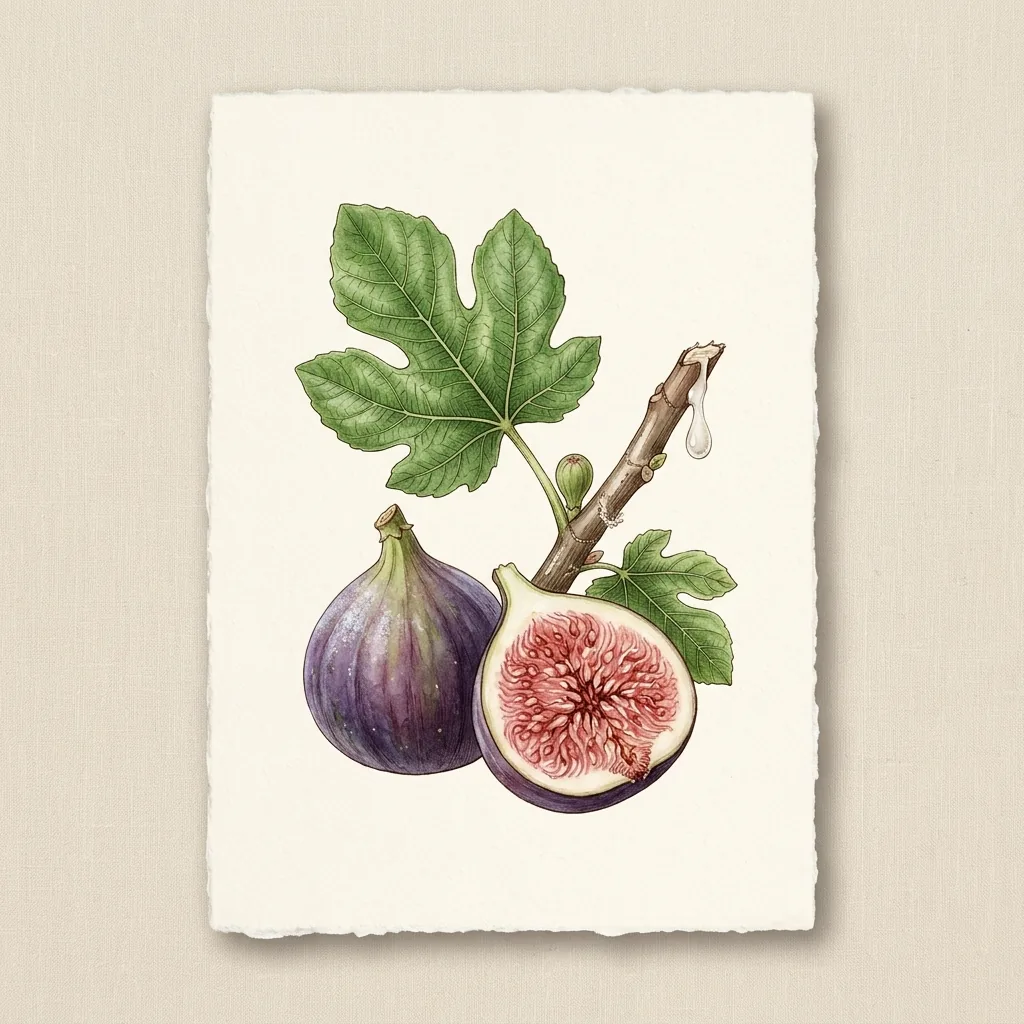
Snap a fig branch along a terraced Levantine hillside in late August and three distinct aromas rise within seconds: the peppery emerald snap of the broad leaf, a bead of cool white latex pooling at the wound, and the jammy honey of split purple skin baking in afternoon heat. Yet search any perfumer's archive from Grasse to Dubai and you will never find pure fig essential oil — because bottling a fig tree is one of haute parfumerie's proudest feats of illusion.
Why a fig tree cannot be distilled
Unlike cedarwood bark or fresh jasmine petals, Ficus carica stubbornly resists every conventional extraction method. Passing boiling steam through ripe figs cooks their water-heavy pulp into flat, lifeless compote stripped of orchard nuance, while hydrocarbon solvents yield little beyond sticky wax and caramelised sugars. Worse still, the natural milky latex running through the leaves and young green stems carries phototoxic furanocoumarins such as psoralen that can irritate sun-exposed skin even in tiny traces.
Rather than surrender such an evocative Mediterranean motif, perfumers turned fig into an architectural fantasy accord aided by modern headspace analysis — capturing the exact volatile molecules hovering around living leaves in sunlit orchards and rebuilding the tree stroke by stroke. The finest fig compositions never isolate the soft fruit alone; they paint the entire sunlit grove from crisp snapped stem down to rough bark and hot limestone.
Crushed emerald leaf and bitter stem
That immediate sensation of stepping out of noon glare beneath a broad, rustling canopy begins with razor-sharp green molecules. Perfumers turn to Stemone — an aromatic oxime smelling vividly of snapped green twigs, cool leaf veins, and shaded sap — alongside trace drops of cis-3-hexenol (leaf alcohol) and resinous Iranian galbanum. Wild trees rooted in dry limestone release far greener, sharper volatiles than irrigated garden trees; guided by a whisper of bright citrus peel to prevent the chord from turning rubbery, these materials capture the dry, faintly raspy underside of a sun-warmed fig leaf rubbed briskly between thumb and forefinger.
Milky sap and bruised purple fruit
Once the crisp green snap settles, the perfumer paints that cool bead of opaque white latex sealing every broken branch. Here noses weave subtle doses of gamma-nonalactone and delta-decalactone into soft coumarin and creamy sandalwood, evoking cool botanical milk and nutty green almond skin without ever sliding into waxy coconut beach lotion.
While daytime colognes often linger happily at sunlit leaf and cool sap, richer evening compositions plunge deep into the split purple fruit itself. Tart blackcurrant bud, jammy damson plum, and velvety berry ionones build wine-dark orchard nectar — succulent, rich, and subtly earthy rather than candied or synthetic. Blackcurrant's crisp sulfur-green lift also creates a seamless bridge from bright green leaves into plush, shadowed purple fruit.
Orchard earth: leather, oud, and ambergris
What gives an illusory fig true staying power is the gnarled trunk and warm limestone earth anchored underneath. Traditional Mediterranean studies root the leaf in dry Atlas cedarwood and grassy vetiver, yet contemporary Arabian-inflected houses elevate dark orchard fig beside supple burnished leather, smoky agarwood, cured vanilla pod, and salty mineral ambergris. Framed against leather and oud, fig sheds its reputation as a fleeting August diversion; two measured sprays on warm skin let the crisp green snap, velvety plum-fig richness, and glowing resinous timber carry smoothly from brisk autumn afternoons straight into candlelit evening wear.
Experience dark orchard fig layered over blackcurrant, ripe plum, supple leather, oud, vanilla, and ambergris in Art of Nature I by Lattafa.