7 min read
Three Years Underground: The Quiet Extravagance of Iris and Orris Butter
The scent of iris doesn't live in its purple petals — it hides in subterranean rhizomes aged for three years until they turn to silver suede.
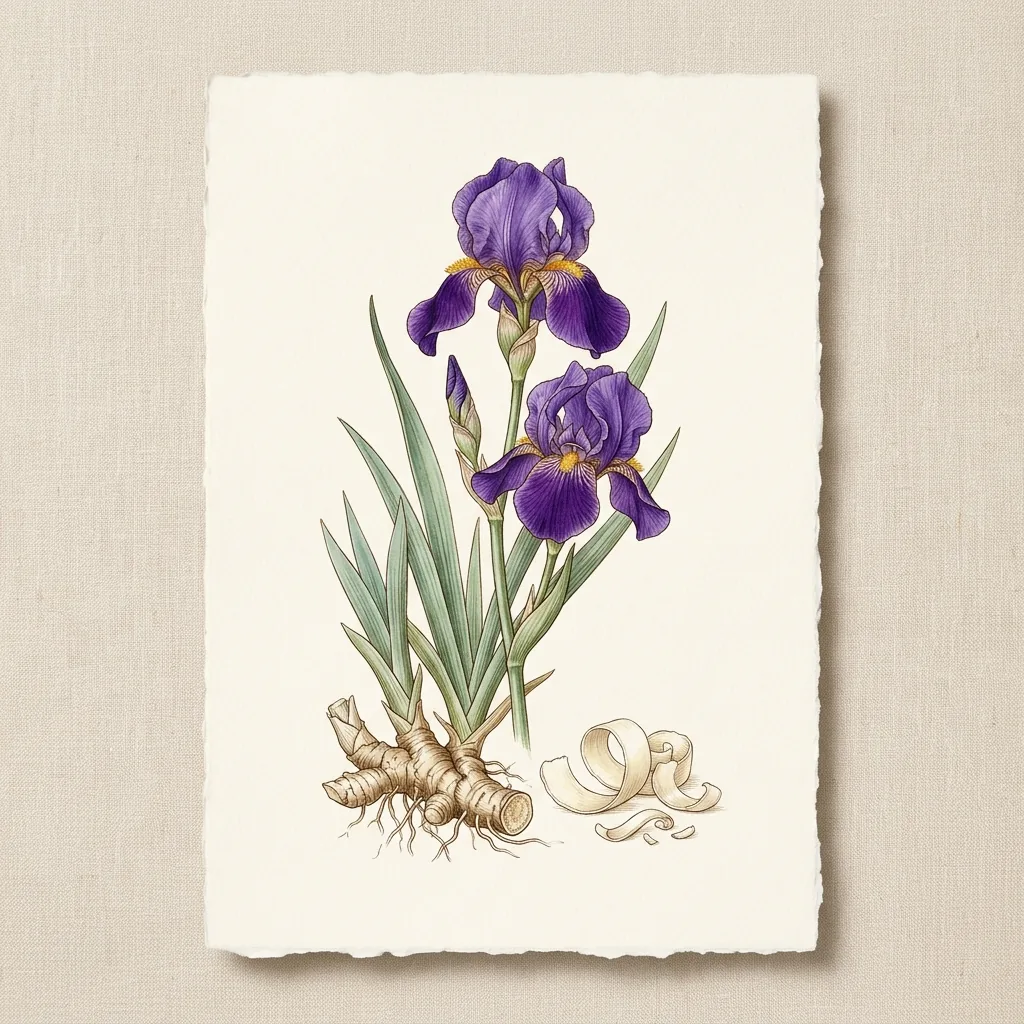
Lean down to inhale a blooming iris on a spring morning — whether pale blue Iris pallida in Florence or Jordan's velvet-black Iris nigricans after desert rain — and you meet an unexpected silence. The flower itself scarcely smells at all. Iris hides its fortune beneath the dirt, inside gnarled subterranean rhizomes that must sleep through years of slow curing before they surrender one of perfumery's rarest treasures: cool, silvery orris butter.
Three years in the soil, three years in stone lofts
Harvesting iris for fragrance tests human impatience. Farmers cultivate Iris pallida and Iris germanica for three full growing seasons simply so the thick underground rhizomes can store starch and aromatic precursors. Once dug up in late summer, each root is scrubbed, peeled carefully by hand with curved knives to remove bitter outer skin, and laid on reed mats in the open sun until bone-dry.
Even then, freshly dried rhizome smells faintly of damp turnip and raw earth. Only during three additional years of storage in breathable burlap sacks inside cool, dark rooms does gentle atmospheric oxidation transform odorless triterpenoids into irones — the luminous ketones behind iris's unmistakable signature. When aged roots are milled and steam-distilled, the distillate solidifies at room temperature into a creamy, pale wax called orris butter (beurre d'iris), yielding mere grams per ton of root and rivaling pure oud and Taif rose in price.
Alabaster, violet leaf, and silver suede
Cheap synthetic ionones can flatten iris into sweet cosmetics or nostalgic face powder. Real orris butter smells far stranger and infinitely more aristocratic. On skin, high-irone orris evokes cool carved alabaster, rain-damp grey slate, crisp starched cotton, and a faint whisper of sweet carrot seed resting over misty violet. There is a tactile dryness to it — never chalky, never suffocating — that settles around the wearer like finely brushed grey suede rather than loud floral perfume.
Grading depends strictly on irone concentration, which perfumers measure carefully between Tuscan Iris pallida — prized for sheer, silky alpha- and gamma-irone elegance — and heartier Moroccan Iris germanica, whose earthier roots carry a slightly greener, drier bite. Even at tiny concentrations below one percent, pure orris butter containing fifteen percent natural irones lends a shimmering cashmere texture that no laboratory shortcut can wholly imitate, wrapping sharp spices and warm resins in effortless stillness.
Why iris conquered modern masculine and unisex perfumery
Once confined to classic feminine bouquets, iris staged a quiet revolution in modern tailoring. Perfumers realized that cool, rooty orris butter behaves like bespoke wool flannel: it brings effortless composure to spicy, resinous, or aromatic structures. Paired with brisk cypress and clean lavender, iris feels razor-sharp and nocturnal; softened by warm cinnamon, benzoin resin, and dark vanilla, that same powdery coolness turns brooding, sensual, and velvet-smooth without losing an ounce of restraint.
Listening for true orris on your skin
Because natural irones travel slowly, an iris-centered fragrance rarely shouts in the first five minutes. Give it half an hour in cool evening air, and watch closely whether the powdery veil stays crisp, waxy, and subtly earthy rather than drifting into sugary candy or flat talcum. Notice also how iris interacts with its companions — lifting aromatic lavender, tempering warm cinnamon, or lending cool poise to benzoin and vanilla. On cool skin or dark knitwear, true orris clings with ghostly persistence, whispering quiet luxury long after louder scents have faded.
Explore velvety iris balanced by cinnamon, lavender, cypress, benzoin, and warm vanilla in His Confession by Lattafa.