6 min read
Moonlight & Indole: Why Jasmine and Tuberose Command After Dark
Picked before dawn when their narcotic oils peak, white flowers carry a secret molecule that makes them feel almost alive on warm skin.
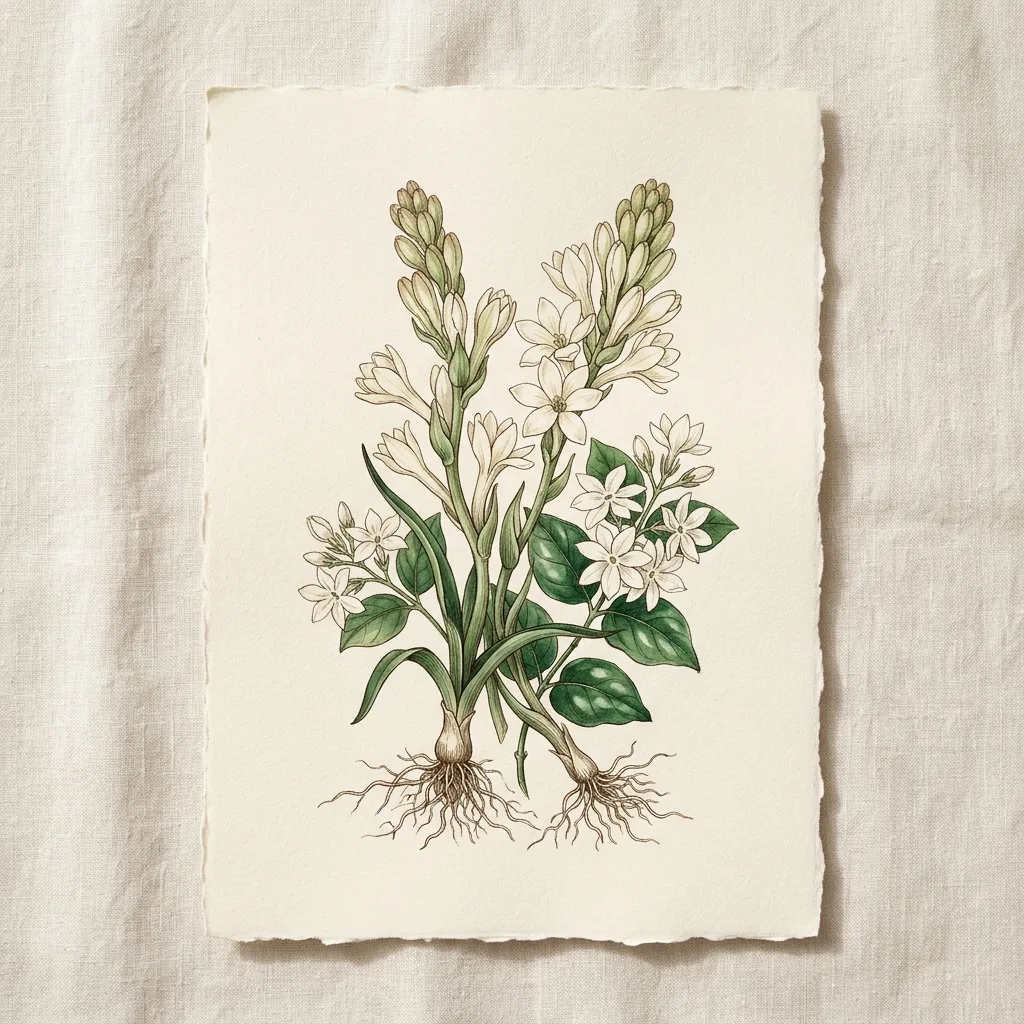
Walk past a courtyard trellis of Arabian jasmine or a vase of cut tuberose at noon and the white petals seem restrained, almost polite. Return after sundown and the air thickens into something hypnotic — creamy, honeyed, faintly animalic, and astonishingly loud for blossoms the size of a thimble. White florals do not bloom for our eyes; they bloom for darkness, and the chemistry behind that twilight surge explains why they remain perfumery's most captivating seductresses.
Blooming for the night shift
Unlike roses or lavender, which signal daytime bees with vivid colour and sun-warmed oils, Jasminum sambac and Polianthes tuberosa evolved to attract nocturnal moths across wide gardens. As dusk cools the leaves, enzymatic pathways inside the petals accelerate, pumping out dense plumes of benzyl acetate, methyl anthranilate, and creamy lactones designed to linger in still night air. Pickers still work by lantern light between two and six in the morning, because a single hour of direct daylight ruptures those volatile esters and flattens the bloom's luminous depth.
Capturing that living aroma also requires gentler methods than standard distillation. Passing boiling steam through jasmine or tuberose petals cooks their fresh nectar into dull, hay-like tea. Instead, perfumers rely on solvent washing to obtain a waxy concrete and, after cold alcohol purification, a dark absolute — echoing the traditional patience of enfleurage, where harvested tuberose buds kept exhaling perfume into purified fat frames for days after leaving the stalk.
Indole: the shadow inside the petal
Examine a gas-chromatography readout of fine jasmine or tuberose absolute and one heterocyclic molecule stands out: indole. Smelled alone as pure white crystals, indole can feel jarring — earthy, slightly phenolic, reminiscent of overripe fruit or warm fur. Yet inside living white petals, indole naturally occurs at just one to three percent alongside velvety peach-like lactones and honeyed floral esters.
In a fragrance formula, indole acts precisely like shadow in chiaroscuro oil painting. Remove it completely and white flowers collapse into squeaky laundry detergent or hollow citrus-blossom water. Retain it in disciplined balance and the petals acquire three-dimensional volume, humid skin warmth, and an unmistakable pulse. That quiet tension — sweet creaminess darkened by raw organic depth — is what makes real jasmine and tuberose feel almost alive on the neck.
Solar milk versus spiced smoke
Perfumers steer that narcotic heart in two contrasting directions. The solar, lactonic route amplifies tuberose's naturally buttery esters with golden ylang-ylang, coconut-milk accords, and honeyed benzoin resin, turning the flower into liquid sunlit silk suited to balmy seaside nights. By contrast, the spiced-incense route — deeply cherished in Arabian perfumery — trades tropical softness for nocturnal chiaroscuro: dry cinnamon bark mirrors jasmine's latent eugenol spice, cool frankincense smoke slices cleanly through thick floral nectar, and roasted tonka bean layered over velvety white musk anchors the petals to warm skin for hours without turning syrupy.
Wearing white florals with effortless poise
Because indolic white florals bloom exponentially with skin temperature, placement matters far more than quantity. Rather than spraying directly beneath your chin where dense benzyl esters can cause olfactory fatigue within minutes, mist the outer wrists, the nape of the neck, or inside a jacket lapel. Give the fragrance twenty unhurried minutes to exhale its initial green-spicy sparkle and settle into its creamy, smoky heart; once evening air cools around you, a single measured trail will announce your presence long before you speak.
Discover how nocturnal jasmine and creamy tuberose melt into warm cinnamon, incense, tonka bean, and musk in Her Confession by Lattafa.